


Wasp Nest Removal: When Should You Call a Professional?
Finding a wasp nest around your Brisbane home can quickly turn a quiet afternoon into a safety concern. Wasps can defend their nest when threatened, and a disturbance can result in multiple stings.
For Queensland homeowners, the practical response is to keep their distance, keep children and pets away, and arrange professional wasp pest control when a nest is active or difficult to reach. Healthdirect notes that wasps can sting repeatedly and that stings can cause serious allergic reactions, including anaphylaxis.
At Auzzie Pest Control, we help Brisbane homeowners and businesses deal with wasp activity safely. This guide explains how to recognise a nest, when to call a professional and how to reduce future nesting.
What Is a Wasp Nest?
A wasp nest is a structure built by wasps to shelter the colony, protect developing young and provide a place for reproduction. The appearance of a nest depends on the wasp species and where it has been built.
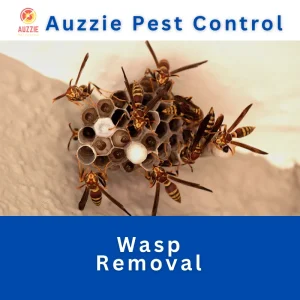
Paper wasps are well known for their open, papery nests, often attached beneath eaves, pergolas, roof edges, balconies, sheds or vegetation. The nest typically has visible hexagonal cells rather than a fully enclosed outer shell. Australian Museum information describes paper wasps as relatively small compared with European wasps and notes their characteristic papery nesting structures.
Other wasps can build nests in less obvious places. A colony may be concealed in a roof void, wall cavity, garden area or underground location. This is one reason simply removing the visible part of a nest may not solve the problem. The active colony may remain nearby or inside a protected space.
In Brisbane’s warm climate, homeowners may notice wasp activity around outdoor living areas, gardens, bins, food preparation spaces and building entry points. The important point is not to judge the risk solely by the size of the nest. A small nest can still contain defensive wasps.
How to Identify a Wasp Nest
The first clue is often repeated wasp activity. If you notice wasps consistently flying into the same opening, returning to the same eave or hovering around one particular section of your garden, there may be a nest nearby.
Common signs include:
- An umbrella-shaped or open paper nest beneath an eave, roof overhang or sheltered structure.
- Multiple wasps entering and leaving one crack, hole or cavity.
- A cluster of wasps around a garden feature, shed, pergola or outdoor entertaining area.
- Paper-like fibres attached to a surface.
- Mud tubes or small mud structures around sheltered areas, which may indicate a mud-dauber type wasp rather than a social wasp colony.
- Increased wasp activity around food, rubbish bins, fallen fruit or sugary drinks.
Do not get close enough to inspect a suspicious nest by hand. — A clear photograph taken from a safe distance can be useful when speaking with a pest professional, but it is not worth approaching the nest simply to identify the species.
Note: Different wasps behave differently, so professional identification matters. Paper wasps, European wasps and solitary species have different nesting habits and treatment needs.
Why Is Wasp Nest Removal Dangerous?
The biggest danger is provoking a colony. Wasps may defend their nest when a person approaches, knocks it, sprays it or attempts to pull it down. Unlike honey bees, wasps can sting repeatedly because they do not leave a barbed sting embedded in the skin.
The risk increases when a nest is near a doorway, children’s play area, pool, deck or bedroom window. A nest in a roof or wall cavity can also be difficult to treat safely because the colony may be concealed.
Another concern is allergic reaction. Healthdirect advises that bee and wasp stings can cause anaphylaxis, a severe and potentially life-threatening allergic reaction. Symptoms can include difficulty breathing, swelling of the tongue or throat, dizziness or collapse.
On an advisory note: Because the consequences of a disturbed colony can be serious, wasp nest removal is not a job where saving a few dollars should be the only consideration.
When Should You Call a Professional for Wasp Nest Removal?
You should contact a professional pest control service when the nest is active, difficult to reach, close to people or pets, or somewhere you cannot safely inspect.
Professional wasp removal is particularly appropriate when:
- The nest is near a doorway, walkway, deck, playground or outdoor entertaining area.
- You can see a steady stream of wasps entering and leaving the nest.
- The nest is high up, such as on a two-storey wall, roof edge or tree.
- Wasps are entering a roof void or wall cavity.
- The nest appears large or there are several nests.
- Someone on the property has a known allergy to insect stings.
- DIY spraying has failed or activity has continued after treatment.
- You cannot confidently identify whether the nest is active.
Act promptly if wasp activity is accelerating. Waiting until a nest becomes larger or harder to access can complicate treatment.
For Brisbane businesses, rentals, childcare settings, hospitality venues and shared residential areas, professional wasp pest control can also help reduce exposure for customers, staff, tenants and visitors.
Why DIY Wasp Nest Removal Can Be Risky
One simple search can reveal various DIY suggestions, from aerosol sprays to knocking nests down with long tools. The problem arises when colony reacts to that simple method.
DIY removal may cause several problems.
- Spraying from close range can disturb the nest before treatment has taken effect.
- Reaching high nests from ladders adds a fall risk.
- Blocking a cavity without knowing where the colony is can force wasps into another part of the building.
- Removing only the visible nest may leave active wasps behind.
A common mistake is assuming that a nest is abandoned because you cannot immediately see wasps around it.
Professional pest technicians are trained to assess access, colony location and treatment requirements before carrying out the work. They also have protective equipment and professional products suited to pest control applications.
Our Auzzie Pest team is fully equipped and well trained to deal with this.
The safest DIY step is observation from a distance. Leave the nest alone and arrange an assessment.
For Further Detail, Read our blog on – Why DIY Wasp Nest Removal Can Be Risky
How Professional Wasp Nest Removal Works
A professional wasp nest removal service generally begins with an inspection. The technician identifies the wasp activity, checks where the nest is located and looks for access points or concealed areas.
The treatment method depends on the situation. An exposed paper wasp nest beneath an eave may be approached differently from a colony inside a wall or roof void. Ground-nesting or concealed colonies require particular care because the main nest may not be visible from the surface.
A typical process may include:
- Inspecting the property and identifying the likely nest location.
- Assessing the species, activity level and access conditions.
- Selecting a targeted treatment method.
- Applying the treatment with appropriate protective equipment.
- Allowing time for the treatment to control active wasps.
- Removing the nest or addressing the affected area where appropriate.
- Checking the site for remaining activity.
- Providing advice on reducing future nesting opportunities.
Not every situation requires the same approach, and responsible treatment should follow product label directions and applicable Australian requirements. The goal is not simply to knock down a nest. Effective wasp control means dealing with the active colony and reducing the chance of continued activity.
Benefits of Hiring a Professional Wasp Pest Control Service
Hiring a professional makes a significant difference when a wasp nest is active or located somewhere difficult to access.
First benefit is safety. Instead of standing beneath an active colony with a spray can, the property owner can keep a safe distance while a trained technician handles the treatment.
Second benefit is accurate assessment. Wasps can build nests in places that are not immediately obvious. A professional can determine whether activity is linked to an exposed nest, cavity or another concealed location.
Thirdly, Treatment can also be more targeted. Rather than repeatedly spraying areas where wasps are seen, the technicians focuses on the source of activity and choose an appropriate method.
There is also convenience. A prompt wasp removal service can help a family reclaim a patio, entrance or garden without experimenting with multiple DIY products.
Auzzie Pest Control provides wasp control services in Brisbane and surrounding South East Queensland areas. Our team handles residential and commercial pest concerns, with treatments tailored to the property and the location of the nest.
How Much Does Wasp Nest Removal Cost in Australia?
There is no single national price for wasp nest removal because every job is different. Current Australian cost guides commonly place basic wasp nest removal in the low hundreds of dollars, with larger, concealed or difficult-to-access nests costing more.
Hipages‘ 2026 guide gives a broad national range of about $100 to $350 for wasp nest removal, noting that nest size and access can increase the price. Its wider pest control guide lists bee and wasp nest removal across a broader range because services and job complexity vary.
For Brisbane customers, Auzzie Pest Control currently lists typical wasp removal at around $120 to $300, depending on accessibility, nest size and infestation level.
The final price can be influenced by:
- Nest size and number of nests.
- Whether the nest is exposed or concealed.
- Height and ease of access.
- Roof void or wall cavity treatment.
- The type of wasp involved.
- Whether additional treatment or follow-up is required.
- The property type and location.
A reliable pest control company like ours explains what is included and price the job according to its actual complexity.
Take a quick look, check out our Quick Book to have quick estimate of our service price.
How to Prevent Wasp Nests Around Your Property
You cannot completely prevent wasps from visiting a Brisbane property, but you can reduce attractants and convenient nesting spots.
Start with Food and Waste: Keep outdoor food covered, clean up spills quickly and keep rubbish bins closed. Wasps can be attracted to food and drinks, particularly sugary items. Collect fallen fruit regularly rather than leaving it in the garden.
Healthdirect also recommends keeping food and drinks covered outdoors and cleaning sticky spills promptly to help reduce wasp encounters.
Inspect the Structure: Look around eaves, pergolas, sheds, roof edges and other sheltered locations for early nest-building activity. Seal suitable cracks and gaps where practical, while avoiding contact with an active nest or cavity.
Keep Garden Areas Maintained: Remove unnecessary clutter that creates protected spaces. Check outdoor play equipment and frequently used areas as part of routine property maintenance.
Early detection is useful because a small nest can be easier to manage than an established colony.
What to Do If You Find a Wasp Nest
The safest response is to stop and create distance.
- Do not hit the nest, shake it, block the entrance, burn it or spray it from close range. Move children and pets indoors or to another safe area and keep people away until it has been assessed.
- From a safe distance, note where the nest is located and, without approaching it, take a photo for the pest technician when practical. Tell the technician whether wasps are entering a wall, roof, ground opening or other concealed area.
- Avoid disturbing nearby vegetation or structures simply to get a better view.
- If anyone is stung, move away from the nest first.
For signs of a severe allergic reaction, use an adrenaline autoinjector if available and call Triple Zero (000). Healthdirect identifies breathing difficulty, throat or tongue swelling, dizziness and collapse among emergency warning signs.
For a suspected active nest in Brisbane, arrange professional wasp pest control like Auzzie Pest Control.
Frequently Asked Questions About Wasp Nest Removal
Can I remove a wasp nest myself?
It is possible to remove an inactive, abandoned nest, but the difficult part is knowing whether it is truly inactive. An active nest can provoke multiple stings when disturbed. For that reason, active or uncertain nests are better assessed by a pest professional.
How do I know if a wasp nest is active?
Regular wasp movement in and out of the nest is a strong indication of activity. You may also notice wasps repeatedly flying to the same cavity or sheltered location. Do not approach the nest to confirm activity.
Are wasps dangerous in Brisbane?
Wasp stings can be painful and can cause serious allergic reactions in some people. Some wasps are also defensive around their nests. The risk depends on factors such as the species, location and level of disturbance, so active nests should be treated carefully.
How quickly can a professional remove a wasp nest?
The time required depends on the nest’s location, size, species and access. A straightforward exposed nest can be relatively quick to treat, while nests in roof spaces, wall cavities or difficult locations may require additional assessment or follow-up.
Will removing the visible nest get rid of all the wasps?
Not necessarily. If the colony is concealed or there is an active source elsewhere, removing one visible structure may not solve the underlying problem. Proper treatment focuses on the source of the activity.
How much does wasp pest control cost in Brisbane?
For many standard jobs, professional removal costs a few hundred dollars rather than thousands. Auzzie Pest Control currently lists typical wasp removal at approximately $120 to $300, depending on access, nest size and infestation level. A site-specific price is more reliable than a generic estimate.
Book Now, to get our cheapest price on various bundled services.
What should I do if someone in my household is allergic to wasp stings?
Keep that person well away from the nest and avoid DIY treatment. Arrange professional removal and follow the person’s prescribed allergy action plan. If a sting causes signs of anaphylaxis, use an adrenaline autoinjector if available and call Triple Zero (000).
Conclusion
A wasp nest is easy to ignore when it is small and tucked away, but the risk changes when the colony is active, growing or close to people. Trying to remove an active nest yourself can provoke defensive behaviour, cause multiple stings and create unnecessary risks from ladders, sprays or hidden colonies.
The practical approach is simple: identify the signs from a safe distance, keep children and pets away, and call a professional when the nest is active, concealed or difficult to reach.
For homeowners and businesses across Brisbane, Auzzie Pest Control provides professional wasp pest control and wasp nest removal tailored to the situation on your property. Getting the problem assessed early can help protect your family, customers, staff and outdoor spaces while reducing the chance of the infestation becoming harder to manage.